People often ask us about the Gauchos in Argentina so we will try to answer some of your questions here starting with information about how the Gauchos dressed.
What is Gauchos’ clothing?
The gaucho is a descendant of the worker of the first cowsheds and the primitive leather industry. So, he dressed with what he had at hand, with what was useful for his work in the fields
Gauchos often dress in a different way according to their region. In the North, the gaucho uses guardamonte to protect himself from the Espinales mountains (forests with thorns), and in some other places, they don’t need it. In Tucumán, for example, the lazo is thrown in the same way, but it is different: others have a ring.
A typical gaucho dress includes a poncho, which is also used for sleeping outdoors, a hat or beret on his head, a large knife at the back of the waist, and baggy pants called bombachas.
The traditional paisana (the gaucho’s wife) from the plains only stands out for its simplicity, the dress does not have strong colors or big flowers, nor does it use showy accessories.
Gaucho clothing
Boots: The traditional one is made of colt leather, it is used for riding or working in the fields, it is a high boot and not laced.
Alpargata (Espadrille): The classic espadrille is made of jute (cáñamo) soles with graphite fabric, but there are versions with leather and rubber soles.
Poncho: Plain, neutral colors, not flashy to distinguish hierarchies, ponchos were and are part of his wealth and his luxuries.
Bombachas: These pants are neither too wide nor are they worn with the button on the cuff detached.
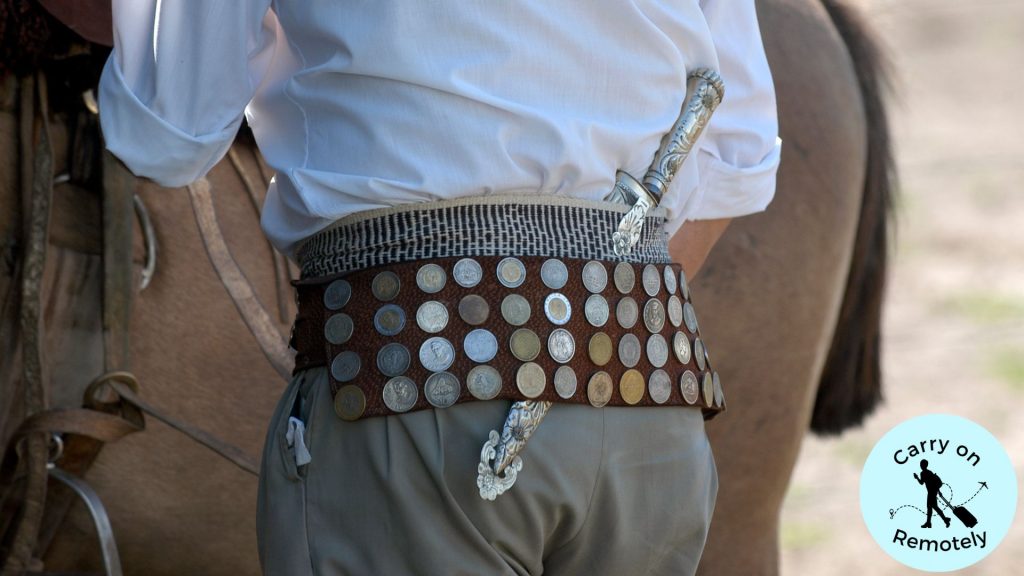
Faja: This sash can go around the waist three or four times, and it is tightened so that the bombachas don’t fall down.
Belt: The center is called rastra and has, almost always, 6 ‘costillas’; at the tip of these costillas there are coins or buckles, three for one side and three for the other, and they are attached to the strap above the belt.
Hat: It is of the short brim except in the North, which is used with a long brim so that it makes shade. In the past, they used to wear a donkey’s belly hat, made from the leather of the donkey’s belly. Today they are “pelo de liebre” (hare’s hair).
Boina (beret): It came with the first Basque immigrants. The inclination is a matter of personal taste, in the past, it was rare for it to go all the way back, or very big, as it is now.
Shirt: It has pockets with flaps to keep the yesquero (lighter) and tobacco. It has long sleeves and no collar (mao collar) for the handkerchief.
Handkerchief: They usually measure up to 90 x 90 cm and are rolled up “as thinly” as possible. It can be opened and stretched, it is like a V in the back. The “prendedura” (the knot) is like that of a bow tie. It prevents the sun from burning the neck and, also, like the beret, it was used to identify political affiliation. In the paisana it is plain, generally light blue or white.
Saco (coat): Like the shirt, it also has no collar and only the two top buttons are fastened to put on the handkerchief, very similar to the Spanish jacket. It has four visible pockets.
The knife: It is not a facon of exaggerated size but a knife with a deer horn, bone, or wood handle. If it has silver and gold inlays “they are only small details” and, like those with a braided leather handle, they are used at parties. When they’re riding, the knife is worn at the back of the waist.

The paisana clothing
Shoes: Chatitas or shoes with a school-type strap, with taquito (small heel) and natural colors or very thin stripes. Never high heels. She can also wear alpargatas (espadrilles) with jute soles with or without laces.
The dress: Full-length, rather narrow, and mid-calf length. The fabric is cotton, no silk or broderie. The print is discreet: small polka dots, simple colors, no big flowers, no big necklines.
Hair: Up-do; bun, one or two braids.
Accessories: Bracelet, wedding ring, Creole ring or pearl, always within the most discreet, nothing flashy.
Makeup: A little for the eyelashes and the cheeks.
What are Gaucho Pants?
Gaucho pants are usually long and baggy and are wide at the ankle. You can find a selection of modern gaucho pants for women on Amazon for sale here.
What kind of shoes do you wear with Gaucho pants?
Traditional footwear varies but most commonly consists of cloth alpargatas or high leather boots.
What is a Gaucho knife?
Historically, the knife was typically the only eating instrument carried by a gaucho.
In addition to a rope made from cow rawhide, the lasso used to catch cattle, gauchos used bolas or boleadoras: three rocks joined together and tied with long leather straps. The bolas are thrown against the legs of an animal to intertwine them and immobilize them.
Who are gauchos in Argentina?
Gauchos were, are, and will continue to be proudly qualified horsemen. For a gaucho, the horse is one of his most precious possessions.
There are annual festivals throughout Argentina which usually include gaucho riding demonstrations.
‘El Día de la Tradición’ (Tradition Day) has been celebrated on November 10 for 80 years as a tribute to the birth of José Hernández (1834-1886), author of “El gaucho Martín Fierro“.
They were nomadic cowboys of the Argentine pampas, renowned for their ability to hunt wild cattle alive.
Hundreds of years of history, legends and ballads have helped define the cultural traditions of the gauchos, embedding their influence deeply in the Argentine cultural tradition.
Because the gaucho played an important role as a gauchisoldado (soldier) in Argentina’s fight for independence, he is respected as a symbol representing Argentina’s nationalist sentiments.
Martín Fierro, the most important gaucho figure in Argentina
José Hernández wrote the most famous work of gaucho literature. He was born on November 10, 1834, in the province of Buenos Aires, on the farm of his uncle Juan Martín de Pueyrredón, but he grew up in the city of Buenos Aires.
At the age of twelve, he moved to the countryside with his father Rafael. This was his first contact with life on the ranches and with the customs of the gauchos, which evidently had a great impact on that child. When he grew up, he took part in national political life and became a deputy.
To write Martin Fierro, Hernandez was inspired by the harsh reality gauchos lived in the late nineteenth century, who had gone from being a free man to a farmhand or soldiers enlisted by force to fight in civil wars.
The Hernández family had a ranch where José spent most of his childhood. In those times the story was told of a gaucho matrero who existed in real life. Some versions indicate that it was this character that inspired José Hernández.
Hernández published El Gaucho Martín Fierro in 1872, and was so successful that he had no choice but to write the continuation of the story. It was published in 1879 and was called La Vuelta de Martín Fierro.
Today the two parts are published together as one. The first book begins with Martín Fierro recalling how happy he lived with his family until he was forced to join the army. He hates this situation and soon rebels and deserts. Upon his return, he discovers that his house was destroyed and his family is gone. Desperate, he joins the Indians and is outlawed.
The Martín Fierro is a poem, that is to say, it is written in verse. But we also say that it is gaucho because of its form: stanzas of six lines each, the second rhyming with the third and the sixth, and the fourth with the fifth. It is the same formula that payadores apply to their verses when they sing.
Where are the Gauchos in Argentina?
The Gauchos lived all over Argentina and also in the South of Brazil and Uruguay. In Argentina, most of the Gauchos lived in the Pampas region.
When were the Gauchos living in Argentina?
The Gauchos were mostly living in the 19th Century and lived off the land so they were semi-nomadic. Many large estates began at the end of the 19th Century and the lifestyle of the Gaucho became less common.
How many Gauchos are there in Argentina?
It’s hard to say that a real “gaucho” is still around in Argentina but there are many people who live a similar life to a Gaucho.
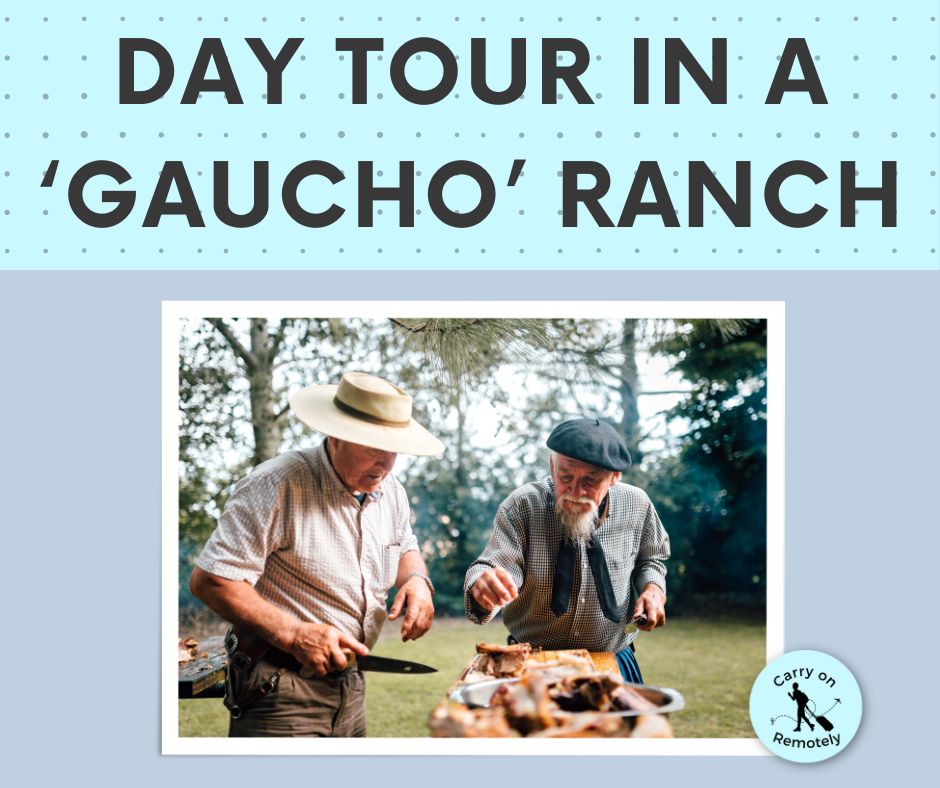
There are people who run tours and show the skills and dress of the Gaucho so you can get some of the experience yourself. You can do this tour from Buenos Aires if you book the tour to an estancia(ranch) here.
Recommended Tours in Buenos Aires

About the author: